
 +91-22-48913909
What is Wallpaper?
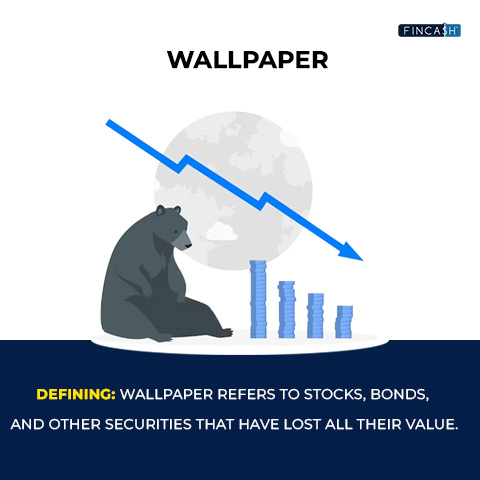
Wallpaper refers to stocks, Bonds, and other securities that have lost all their value. Despite the shift to digital formats, the term "wallpaper" has endured and now signifies the worthlessness of a stock or bond certificate or any other exercisable right to securities like stock options, usually resulting from reasons such as Bankruptcy.
In periods of economic decline, such as the Great Depression, stock certificates that had become worthless were sometimes repurposed as insulation or even used as actual wallpaper. This creative utilisation of useless stocks was a practical way to make the best of a challenging financial situation, turning once valuable paper into functional household materials.
The History of the Term “Wallpaper”
The term "wallpaper" originated from the idea that since the worthless stock certificates had no financial value, they could be used as decorative wallpaper for houses during the Great Depression. This practice emerged after the Stock Market Crash of 1929, which resulted in the loss of billions and numerous bankruptcies. With physical paper certificates representing ownership of shares in companies, many investors were left with stacks of useless paper. Those fortunate enough to have shelter but lacking proper insulation would repurpose the worthless stock certificates to cover their walls, serving as a makeshift solution to block drafts.
In some cases, individuals may have sarcastically adorned their walls with worthless certificates as a form of ironic decoration. Today, the term "wallpaper" is used more broadly to describe any security that has lost all value, regardless of whether there is a practical use for it or not. It's worth noting that old stock certificates should not be discarded hastily, as some may hold historical or collectible value.
Talk to our investment specialist
Recent Examples of Wallpaper
Indeed, there are some latest examples of companies that have become "wallpaper" due to significant financial downturns. Here are a few of them:
Pets.com: Pets.com was an online retailer that gained substantial attention during the dotcom bubble in the late 1990s. However, it faced financial challenges and ultimately filed for bankruptcy in 2000
Webvan: Webvan was a prominent online grocery delivery company that aimed to revolutionize the Industry. Despite raising substantial funds during the dotcom era, it failed to turn a profit and filed for bankruptcy in 2001
Lehman Brothers: Lehman Brothers, a renowned global financial services firm, faced severe difficulties during the Great Recession in 2008. The company, heavily involved in the subprime mortgage market, encountered significant losses, leading to its collapse and bankruptcy, which had far-reaching consequences for the financial industry
These examples highlight how companies once prominent and perceived as valuable became "wallpaper" when their financial situations deteriorated significantly.
Collectible Wallpaper
Old securities certificates have gained popularity as collectibles, often appreciated for their artistic value, historical significance, or association with famous individuals or notable companies and governments. Collectors have been known to pay significant amounts, sometimes in the thousands of dollars, for certificates that possess desirable qualities. The practice of collecting such out-of-date or worthless stock and bond certificates is known as scripophily. It is an engaging hobby for those interested in financial history, art, or the nostalgia associated with obsolete financial instruments.
Scripophily enthusiasts seek certificates with unique designs, elaborate engravings, rare signatures, or those connected to significant events. By collecting and preserving these certificates, enthusiasts contribute to preserving financial history and appreciating the artistry involved in their creation. The value of these collectibles is determined by factors such as rarity, demand, condition, and historical significance.
Special Considerations
You make an excellent point! Individuals who possess old stock certificates from companies that no longer exist should not automatically assume they are worthless. Despite decades of mergers, acquisitions, name changes, and stock splits, the value of a stock can persist in various forms.
There are several potential scenarios where an old stock certificate may hold value:
Active Companies: Sometimes, a long-gone company might have undergone name changes or mergers but still operates under a different name. Holding stock certificates from such a company may still represent ownership in an active, valuable corporation.
Historical Value: The stock certificates can have historical significance even if a company is no longer active. As mentioned earlier, collectors and enthusiasts of financial history may be interested in acquiring these certificates and may be ready to pay a premium for their collectible or artistic value.
Scripophily Market: The market for collecting old stock and bond certificates, known as scripophily, can offer opportunities for individuals to sell their certificates to collectors. Depending on the certificates' uniqueness, rarity, and desirability, collectors may be willing to pay good money to add them to their collections.
Without further investigation, it's crucial not to dismiss old stock certificates as worthless. Researching the company's history, consulting with experts, or reaching out to collectors and dealers in the scripophily market can help determine the potential value of such certificates. As the saying goes, "One person's junk may be another person's treasure," so it's worth exploring the possibilities before assuming worthlessness.
All efforts have been made to ensure the information provided here is accurate. However, no guarantees are made regarding correctness of data. Please verify with scheme information document before making any investment.



AMFI Registration No. 112358 | CIN: U74999MH2016PTC282153
Shepard Technologies Pvt. Ltd. (with ARN code 112358) makes no warranties or representations, express or implied, on products offered through the platform. It accepts no liability for any damages or losses, however caused, in connection with the use of, or on the reliance of its product or related services. Terms and conditions of the website are applicable.
©2026 Shepard Technologies Private Limited. All Rights Reserved