
 +91-22-48913909
Top 8 Best Government Investment Schemes in India
Many investors wish to ensure investments with high returns as early as possible—without taking the risk of losing their principal amount. The idea of earning stable returns with complete safety is something almost everyone looks for. However, in reality, a low-risk and high-return combination does not exist. Returns and risks tend to be directly proportional—going hand in hand. This means that higher returns usually come with higher risk, and safer investments typically offer moderate returns.
That said, government-backed investment schemes in India come closest to striking this balance. They offer safety of capital, stable returns, and tax benefits—making them highly attractive for conservative investors.
But here’s the real question:
👉 Which government scheme is actually best for you?
Let’s understand this in detail.
Quick Comparison of Best Government Schemes
| Scheme | Returns (Approx) | Risk | Lock-in | Best For |
|---|---|---|---|---|
| SSY | ~8.2% | Very Low | 21 yrs | Girl child savings |
| PPF | ~7.1% | Very Low | 15 yrs | Long-term wealth |
| NPS | 8–10% (market-linked) | Moderate | Till retirement | Retirement planning |
| NSC | ~7.7% | Low | 5 yrs | Safe fixed returns |
| APY | Fixed pension | Very Low | Till 60 | Unorganised sector |
| PMVVY | ~7.4% | Very Low | 10 yrs | Senior citizens |
| SGB | 2.5% + gold returns | Low | 8 yrs | Gold Investment |
| PMJDY | No returns | Very Low | No lock-in | Financial inclusion (banking) |
Note: PMJDY is not an investment scheme but a financial inclusion initiative. It is included here for completeness as it provides access to basic financial services.
How to Choose the Right Government Scheme
Choosing the right government scheme is not just about returns. It depends on your goals, time horizon, and financial situation.
Let’s simplify this:
1. Investment Goal
- Long-term wealth creation → PPF, NPS
- Child’s future → SSY
- Retirement income → NPS, PMVVY
- Safe short-term savings → NSC
Your investment should always start with a clear goal. If your goal is long-term wealth, PPF or NPS makes sense. If you are planning for your child’s future, SSY is more suitable. For retirement income, schemes like NPS or PMVVY work better, while NSC is ideal for short-term safety.
2. Time Horizon
- Less than 5 years → NSC
- 5–15 years → PPF
- 15+ years → SSY, NPS
The duration of your investment plays a crucial role. If you need money within a few years, shorter-term options like NSC are better. For medium to long-term goals, PPF works well, while SSY and NPS are more suited for long-term commitments.
Talk to our investment specialist
3. Liquidity Needs
- Need money early → Avoid long lock-in schemes
- Comfortable locking money → Choose long-term options
Most government schemes come with lock-in periods. If you think you may need access to your money in the near future, it is better to avoid schemes like PPF or SSY, which have longer lock-ins.
4. Risk Appetite
- Very low risk → PPF, SSY, NSC
- Moderate risk → NPS (market-linked)
Every investor has a different comfort level with risk. If you prefer complete safety, fixed-return schemes are suitable. However, if you are open to slightly higher risk for better returns, NPS can be considered.
👉 Choosing the right scheme is not about picking the highest return—it is about selecting what fits your life.
Latest Interest Rates (2026)
Note: Interest rates are revised quarterly by the Government of India.
- PPF: ~7.1%
- SSY: ~8.2%
- NSC: ~7.7%
- PMVVY: ~7.4%
- SGB: 2.5% + gold price appreciation
Best Indian Government Schemes
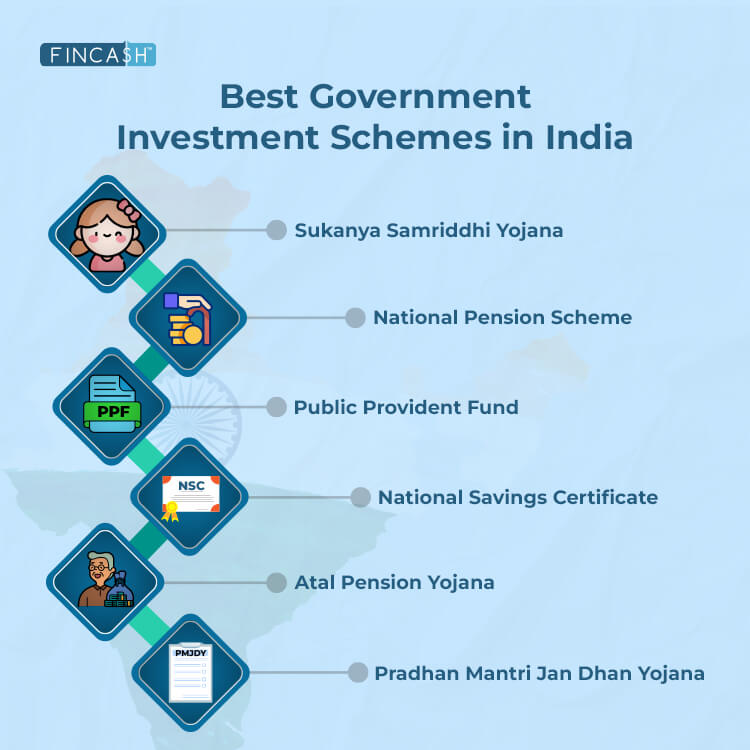
If you are looking to invest in reliable government-backed schemes, here are some of the best options available—each designed with a specific purpose in mind.
1. Sukanya Samriddhi Yojana (SSY)
Sukanya Samriddhi Yojana was launched to encourage parents to secure the financial future of their daughters under the Beti Bachao Beti Padhao initiative.
➤ Purpose: To help families build a dedicated fund for a girl child’s education and marriage.
- Eligibility: Girl child below 10 years
- Investment: ₹250 to ₹1.5 lakh annually
- Interest Rate: ~8.2%
- Tenure: 21 years
➤ Who should invest:
- Parents with a girl child looking for long-term savings
- Families who want a safe, disciplined investment option
➤ Who should avoid:
- Those who may need liquidity in the short term
- Investors without a girl child (not eligible)
This scheme stands out for its high returns and tax-free maturity.
2. National Pension Scheme (NPS)
NPS is a government-backed retirement scheme that allows individuals to invest in a mix of equity and debt instruments.
➤ Purpose: To create a steady income stream after retirement.
- Returns: 8–10% (market-linked)
- Tax Benefit: ₹50,000 additional deduction under Section 80CCD(1B)
- Eligibility: 18–70 years (partial withdrawals allowed under conditions; full exit rules apply at retirement)
- In NPS, 60% withdrawal at retirement is tax-free, while the remaining 40% must be used to purchase an annuity (taxed as per income).
➤ Who should invest:
- Salaried individuals Planning for retirement
- Investors comfortable with market-linked returns
➤ Who should avoid:
- Those looking for guaranteed returns
- Investors needing flexibility before retirement
It is suitable for individuals who want long-term growth along with retirement security.
3. Public Provident Fund (PPF)
PPF is one of the oldest and most trusted savings schemes in India, known for its safety and tax benefits.
➤ Purpose: To encourage long-term disciplined savings with guaranteed returns.
- Interest Rate: ~7.1%
- Tenure: 15 years
- Tax Status: EEE
- Partial withdrawals are allowed after 5 years, and loans can be taken against the balance from the 3rd year.
➤ Who should invest:
- Risk-averse investors
- Individuals looking for tax-saving options
- Long-term planners
➤ Who should avoid:
- Those who need liquidity in less than 5–7 years
- Investors looking for high growth
It is ideal for stable, risk-free compounding.
4. National Savings Certificate (NSC)
NSC is a fixed-income investment option designed to promote savings.
➤ Purpose: To provide a safe and predictable investment option for medium-term goals.
- Interest Rate: ~7.7%
- Tenure: 5 years
- Tax Benefit: Section 80C
➤ Who should invest:
- Conservative investors
- Those looking for safe 5-year investments
➤ Who should avoid:
- Investors seeking liquidity before 5 years
- Those looking for market-linked higher returns
Interest is compounded annually and paid at maturity. The interest earned is taxable, but qualifies for deduction under Section 80C (except in the final year). The scheme works well for predictable returns without risk.
5. Atal Pension Yojana (APY)
APY is aimed at providing pension benefits to workers in the unorganised sector.
➤ Purpose: To ensure financial security and a fixed pension during old age.
- Entry Age: 18–40 years
- Pension: ₹1,000–₹5,000 per month
- Contribution: Till age 60
➤ Who should invest:
- Individuals in the unorganised sector
- Those without formal retirement plans
➤ Who should avoid:
- High-income individuals with existing retirement plans
- Those looking for flexible withdrawal options
It builds a basic retirement safety net.
6. Pradhan Mantri Vaya Vandana Yojana (PMVVY)
PMVVY is designed for senior citizens who need regular income after retirement.
➤ Purpose: To provide guaranteed pension income.
- Returns: ~7.4%
- Tenure: 10 years
- Pension: Monthly/Quarterly/Annual
➤ Who should invest:
- Senior citizens looking for stable income
- Retirees seeking low-risk investments
➤ Who should avoid:
- Younger investors (not eligible)
- Those seeking high growth
It offers stability and predictable income.
7. Sovereign Gold Bonds
SGBs allow investment in gold without physically holding it.
➤ Purpose: To provide a safe alternative to physical gold.
- Interest: 2.5% annually
- Additional Return: Gold price appreciation
- Tenure: 8 years
- Capital Gains on maturity are tax-free, making SGBs highly tax-efficient compared to physical gold.
➤ Who should invest:
- Investors looking to diversify into gold
- Those avoiding storage and making charges
➤ Who should avoid:
- Short-term investors
- Those needing immediate liquidity
It is a smart way to invest in gold efficiently.
8. Pradhan Mantri Jan Dhan Yojana (PMJDY)
PMJDY focuses on financial inclusion by providing banking access.
➤ Purpose: To bring unbanked individuals into the financial system.
- Zero balance account
- insurance and overdraft facility
- Basic banking services
➤ Who should use:
- Individuals without access to banking
- Low-income households
➤ Who should avoid:
- Investors looking for returns (not an investment product)
- It acts as a financial foundation rather than an investment.
Tax Benefits of Government Schemes
Government schemes are not just safe—they are also highly tax-efficient, which improves your overall returns.
➤ Section 80C (up to ₹1.5 lakh) PPF, SSY, and NSC qualify for tax deduction under this section, helping you reduce your taxable income.
➤ Section 80CCD(1B) An additional deduction of ₹50,000 is available exclusively for NPS investments, over and above the 80C limit.
➤ Tax-Free Returns (EEE Category) PPF and SSY fall under the Exempt-Exempt-Exempt category, which means:
- Investment is tax-free
- Interest earned is tax-free
- Maturity amount is also tax-free
➤ Why this matters These tax benefits significantly improve your effective returns when compared to taxable options like fixed deposits, especially in the long term.
Common Mistakes to Avoid
Many investors make these mistakes:
- Investing only for tax saving
- Ignoring lock-in periods
- Putting all money in one scheme
- Expecting very high returns from safe investments
- Not reviewing interest rate changes
Avoiding these mistakes can make a bigger difference than selecting the “best” scheme.
Government Schemes vs Mutual Funds vs Fixed Deposits
| Feature | Govt Schemes | Mutual Funds | Fixed Deposits |
|---|---|---|---|
| Risk | Low | Moderate–High | Low |
| Returns | 7–8% | 10–12% (avg) | 5–7% |
| Tax Efficiency | High | Moderate | Low |
| Liquidity | Low | High | Medium |
Government schemes are best for safety, while mutual funds help in long-term wealth creation.
Ideal Investment Strategy
Instead of relying on a single scheme, a balanced approach works better:
40% → PPF (stability) 30% → NPS (growth) 20% → Mutual Funds (wealth creation) 10% → SGB (diversification)
This creates a well-rounded Portfolio balancing risk and return.
Note: This is a general illustration and should be adjusted based on individual Financial goals and risk profile.
FAQs
1. What are government savings schemes?
A: These are schemes launched by the government to encourage savings and provide stable returns with safety.
2. Which is the safest investment option in India?
A: PPF, SSY, and NSC are among the safest as they are backed by the government.
3. Which government scheme offers highest return?
A: SSY currently offers one of the highest fixed returns, while NPS has higher potential due to market exposure.
4. Can I invest in multiple schemes?
A: Yes, diversification across schemes is recommended.
5. Are government schemes better than FD?
A: In many cases, yes—especially due to better tax benefits and competitive returns.
Conclusion
Government investment schemes play a crucial role in building a stable financial future. While they may not offer extremely high returns, they provide safety, consistency, and tax benefits that are difficult to ignore. The key is not to find the “best” scheme—but to find the right mix of schemes that aligns with your financial goals. When used wisely, these schemes can form the foundation of a strong and secure investment portfolio.
All efforts have been made to ensure the information provided here is accurate. However, no guarantees are made regarding correctness of data. Please verify with scheme information document before making any investment.










AMFI Registration No. 112358 | CIN: U74999MH2016PTC282153
Shepard Technologies Pvt. Ltd. (with ARN code 112358) makes no warranties or representations, express or implied, on products offered through the platform. It accepts no liability for any damages or losses, however caused, in connection with the use of, or on the reliance of its product or related services. Terms and conditions of the website are applicable.
©2026 Shepard Technologies Private Limited. All Rights Reserved
Good for students
Very informative for new invester