
 +91-22-48913909
Best SIP Plans for 5 Years in India – Top Mutual Funds & Returns Guide
Choosing the Top SIP for a 5-year investment is one of the most common questions Indian investors ask today — especially for goals like buying a car, planning a wedding, or creating a home down payment.
The short answer is — there is no single best SIP for everyone.
The right mutual fund for a 5-year SIP depends on:
- Your financial goal
- Your risk tolerance
- The time available before you need the money
- The mutual fund category
- The fund's consistency and risk characteristics

A SIP is simply a method of Investing a fixed amount at regular intervals in a mutual fund. It does not make the underlying investment risk-free or guarantee returns. AMFI describes SIP as a way to invest a fixed amount periodically and notes that it can help investors maintain discipline and benefit from rupee-cost averaging.
For a 5-year goal, the focus should therefore be on choosing an appropriate fund category first and selecting an individual fund second.
Best SIP Options for 5-Year Investment (Quick Summary)
| Investor Profile | Mutual Fund Categories to Consider |
|---|---|
| Conservative | Hybrid Funds |
| Moderate | Large Cap/ Flexi Cap |
| Moderate–Aggressive | Flexi Cap / Large & Mid Cap |
| High Risk | Higher-risk equity categories should be considered cautiously for a 5-year goal |
Important: A 5-year horizon does not automatically make equity Mutual Funds suitable for every investor. If the money is required on a fixed date, the possibility of a market fall near the end of the five-year period should be considered.
What Is a SIP?
A Systematic Investment plan (SIP) allows an investor to invest a fixed amount in a mutual fund scheme at regular intervals, such as monthly. Instead of investing a large amount at one time, the investor spreads the investment over multiple instalments.
For example, an investor could invest:
- ₹2,000 per month
- ₹5,000 per month
- ₹10,000 per month
- ₹20,000 per month
The amount and frequency depend on the investor and the particular mutual fund scheme.
SIP can help investors invest regularly without trying to predict the best day to enter the market. Because units are purchased at different NAVs over time, the average purchase cost may benefit from market fluctuations. However, SIP does not eliminate market risk or guarantee profits.
Talk to our investment specialist
Is 5 Years a Good Period for SIP?
Five years can be a reasonable investment horizon for some mutual fund investors, but whether it is appropriate depends on the fund category and the investor's goal. The important question is not simply:
"Is 5 years enough for SIP?"
It is:
"Is five years enough for the particular type of mutual fund I am investing in, and can I tolerate the risk if the market falls when I need the money?"
For example, a diversified equity fund may experience significant fluctuations even over a five-year period. A Hybrid Fund may have a different risk profile because it invests across asset classes.
Therefore, investors should avoid selecting a fund solely because it delivered the highest recent return.
Which Mutual Fund Categories Can Be Considered for a 5-Year SIP?
1. Large Cap Funds
Large cap funds primarily invest in large, established companies. They may be considered by investors who want equity exposure but prefer a relatively more established segment of the equity market. However, large-cap funds are still equity investments and can fall substantially during market corrections.
Suitable for: Investors with moderate risk tolerance who can accept equity-market fluctuations.
2. Flexi Cap Funds
Flexi Cap Funds have the flexibility to invest across large-cap, mid-cap and small-cap companies. This flexibility can allow the fund manager to adjust the Portfolio across market-cap segments depending on the investment strategy and market conditions.
Suitable for: Investors with moderate to high risk tolerance who want diversified equity exposure.
3. Large & Mid Cap Funds
Large & mid cap funds invest across both large-cap and mid-cap companies. They may offer a balance between established businesses and companies with potentially higher growth opportunities, although the mid-cap exposure also increases the potential for Volatility.
Suitable for: Investors comfortable with higher equity-market fluctuations.
4. Hybrid Funds
Hybrid Funds invest across more than one asset class, depending on the scheme's mandate. Some hybrid categories have a meaningful allocation to both equity and debt, which can make them relevant for investors who want a combination of growth potential and diversification.
Suitable for: Investors who want exposure to multiple asset classes and have a lower risk tolerance than a pure-equity investor.
How to Choose the Best SIP Plan for a 5-Year Goal
Choosing the right SIP for a 5-year financial goal doesn’t have to be complicated. However, instead of simply looking for the fund with the highest returns, it helps to follow a structured approach based on your goal, risk tolerance, fund category and investment consistency.
Here’s a practical way to choose a suitable SIP for a 5-year horizon.
Step 1: Start With Your Financial Goal
First, understand why you are investing and when you will need the money. A 5-year SIP could be for goals such as:
- Buying a car
- Funding education
- Wedding expenses
- Making a home down payment
- Building a corpus for another medium-term financial goal
If the money is required on a fixed date, the ability to protect your accumulated corpus as the goal approaches becomes increasingly important. This is particularly relevant for equity-oriented investments, where the value can fluctuate significantly over shorter periods.
Step 2: Understand Your Risk Comfort
Ask yourself one simple question - How much market volatility can I genuinely handle without stopping my SIP or withdrawing my investment?
Your answer should influence the type of mutual fund category you consider.
- Lower risk tolerance: Suitable hybrid fund categories may be considered for investors who want relatively lower equity exposure.
- Moderate risk tolerance: Large-cap or suitable hybrid fund categories may be considered, depending on the goal and overall portfolio.
- Higher risk tolerance: Diversified equity categories such as Flexi-Cap or Large & Mid-Cap Funds may be considered, but they can experience larger short-term fluctuations.
The important point is that risk tolerance and investment horizon should be considered together. A fund that may be suitable for a long-term investor may not necessarily be appropriate when the money is needed on a fixed date in five years.
Step 3: Select the Right Fund Category
Once you understand your goal and risk tolerance, select the fund category before choosing an individual scheme.
For a 5-year horizon, investors may consider categories such as:
- Hybrid Funds: Can be considered when relatively lower equity exposure is preferred.
- Large-Cap Funds: Invest predominantly in large companies and may be considered by investors looking for exposure to relatively established businesses.
- Flexi-Cap Funds: Offer diversified equity exposure across market capitalisations but can still experience significant market volatility.
- Large & Mid-Cap Funds: Combine exposure to large- and mid-cap companies and may suit investors comfortable with higher equity-market fluctuations.
The right category depends on your financial goal, risk tolerance and ability to remain invested through market cycles.
Step 4: Evaluate the Fund Properly
Once you have selected a suitable category, compare individual mutual fund schemes using multiple factors rather than choosing the fund with the highest recent return.
Some important factors to evaluate include:
- Consistency of Returns
Look at the fund's performance across multiple periods rather than relying only on its latest one-year or three-year return. Rolling returns can provide a better picture of how consistently a fund has performed across different periods.
- Risk-Adjusted Performance
Returns should always be considered alongside the amount of risk taken to generate them. Metrics such as the Sharpe Ratio can help investors understand whether the returns generated by a fund have been reasonable relative to its volatility.
- Volatility
Two funds may generate similar returns while taking very different levels of risk. Check measures such as standard deviation and compare the fund's volatility with other funds in the same category. A higher-return fund is not automatically the better choice if the additional return comes with substantially higher volatility.
- Expense Ratio
The expense ratio represents the cost charged by the mutual fund for managing the scheme. Compare the expense ratio with relevant funds in the same category. While cost should not be the only deciding factor, lower costs can help reduce the drag on long-term returns.
- Fund History
A fund with a longer track record provides more information about how it has behaved across different market conditions. Ideally, evaluate a fund's performance through multiple market cycles rather than judging it on a single favourable period.
- Portfolio
Look at where the fund is investing. Check its sector allocation, major holdings, market-cap exposure and overall diversification. The portfolio should be consistent with the fund category and your own risk tolerance.
- Fund Manager and Investment Strategy
Review the fund's investment approach and the consistency of its strategy. If there have been significant changes in the fund manager, investment mandate or portfolio strategy, understand how these changes could affect the scheme before making an investment decision.
Should You Avoid High-Risk Funds for a 5-Year Goal?
A 5-year investment horizon requires more caution with highly volatile categories.
Small-cap, sectoral, thematic and certain international Equity Funds can experience substantial fluctuations. While they may offer higher growth potential over longer periods, their short- and medium-term performance can be difficult to predict.
Therefore, these categories may not be suitable for investors who have a fixed 5-year goal and limited flexibility around when the money must be withdrawn. If you have a longer investment horizon and can tolerate significant market fluctuations, the suitability of these categories may be different.
Step 5: Review Your Investment Once a Year
Choosing a fund does not mean you need to monitor it every day. For a SIP, an annual review is generally more useful than reacting to every short-term market movement.
During your review, check -
- Whether the fund continues to follow its stated investment strategy
- How it has performed against its category and relevant benchmarks
- Its performance across different periods
- Any major changes in the portfolio
- Changes in the fund manager or investment approach
- Any significant change in the Risk-o-Meter
If the fund continues to meet your requirements and its investment strategy remains consistent, there may be no reason to make frequent changes. However, if there is a persistent deterioration in performance, a major change in strategy, or a change in your own financial goal or risk tolerance, reassess the investment.
Should You Choose a Fund Based Only on 3-Year or 5-Year Returns?
No.
Historical returns are useful for evaluating a fund, but they should not be treated as a prediction of future performance. A fund that has delivered the highest recent return may have achieved that performance by taking higher risks or benefiting from a particular market environment.
For a 5-year investment goal, a better approach is to consider:
Returns + consistency + risk + portfolio + costs + suitability
rather than - Highest return = Best fund
Past performance does not guarantee future performance, and mutual fund investments are subject to market risk.
Expected SIP Returns for 5-Year Investment
Based on long-term historical data:
| Fund Category | Expected CAGR |
|---|---|
| Hybrid Funds | 8% – 10% |
| Large Cap Funds | 10% – 11% |
| Flexi Cap Funds | 11% – 13% |
| Large & Mid Cap | 12% – 14% |
These are indicative returns, not guaranteed. Actual returns depend on market cycles and discipline.
How Much Can SIP Grow in 5 Years?
| Monthly SIP | Approx Value (12% CAGR) |
|---|---|
| ₹3,000 | ₹2.45 lakh |
| ₹5,000 | ₹4.10 lakh |
| ₹10,000 | ₹8.20 lakh |
| ₹20,000 | ₹16.40 lakh |
The above figures are indicative and based on assumed returns.
Your actual SIP returns will depend on:
- monthly SIP investment amount
- investment duration
- expected rate of return
To calculate your personalised SIP returns:
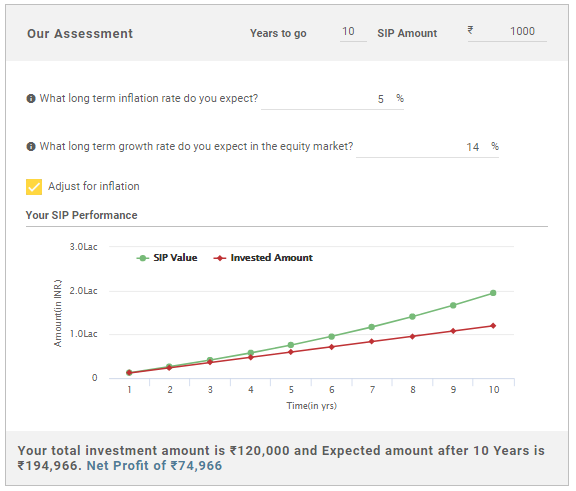
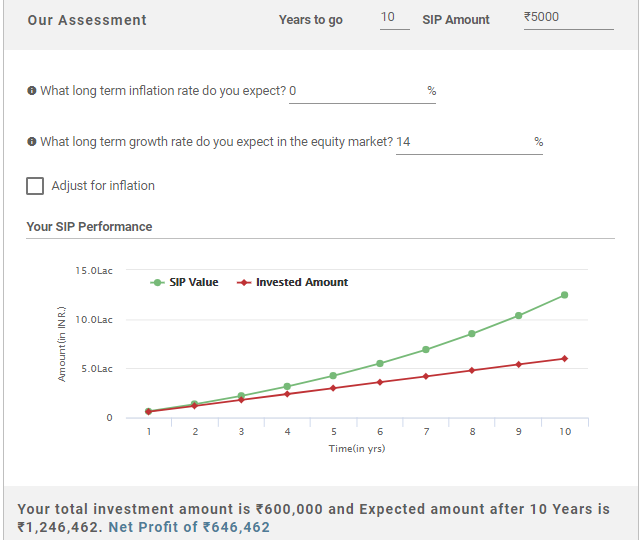
➡️ Use Fincash sip calculator to estimate your 5-year investment value. 🔗 Calculate SIP Returns Instantly
Fund Selection Methodology used to find 10 funds
Best SIP Plans for 5 Year Investment in FY 26 - 27
Fund NAV Net Assets (Cr) Min SIP Investment 3 MO (%) 6 MO (%) 1 YR (%) 3 YR (%) 5 YR (%) 2025 (%) DSP World Gold Fund Growth ₹55.7425
↑ 0.68 ₹1,828 500 12.2 -12.4 18.4 51.7 25.4 167.1 Aditya Birla Sun Life Gold Fund Growth ₹42.0169
↑ 0.19 ₹1,843 100 3.1 -4.4 13.9 33.6 23.4 72 SBI Gold Fund Growth ₹42.3016
↑ 0.12 ₹17,647 500 3 -4.4 13.9 33.6 23.5 71.5 ICICI Prudential Regular Gold Savings Fund Growth ₹44.728
↑ 0.17 ₹7,149 100 3.1 -4.5 14 33.4 23.4 72 HDFC Gold Fund Growth ₹43.1324
↑ 0.13 ₹12,359 300 3 -4.4 13.6 33.4 23.3 71.3 Invesco India Gold Fund Growth ₹40.7054
↑ 0.14 ₹511 500 3.5 -3.7 14.8 33.3 23.2 69.6 Nippon India Gold Savings Fund Growth ₹55.2551
↑ 0.17 ₹7,602 100 3.1 -4.4 13.7 33.3 23.2 71.2 IDBI Gold Fund Growth ₹37.4928
↑ 0.26 ₹858 500 2.9 -4.2 13.3 33.2 23.4 79 Kotak Gold Fund Growth ₹55.4649
↑ 0.15 ₹7,195 1,000 3.1 -4.3 14 33.1 23 70.4 Axis Gold Fund Growth ₹41.98
↑ 0.18 ₹3,191 1,000 3.1 -4.6 13.7 33 23.4 69.8 Note: Returns up to 1 year are on absolute basis & more than 1 year are on CAGR basis. as on 15 Oct 26 Research Highlights & Commentary of 10 Funds showcased
Commentary DSP World Gold Fund Aditya Birla Sun Life Gold Fund SBI Gold Fund ICICI Prudential Regular Gold Savings Fund HDFC Gold Fund Invesco India Gold Fund Nippon India Gold Savings Fund IDBI Gold Fund Kotak Gold Fund Axis Gold Fund Point 1 Bottom quartile AUM (₹1,828 Cr). Lower mid AUM (₹1,843 Cr). Highest AUM (₹17,647 Cr). Upper mid AUM (₹7,149 Cr). Top quartile AUM (₹12,359 Cr). Bottom quartile AUM (₹511 Cr). Upper mid AUM (₹7,602 Cr). Bottom quartile AUM (₹858 Cr). Upper mid AUM (₹7,195 Cr). Lower mid AUM (₹3,191 Cr). Point 2 Oldest track record among peers (19 yrs). Established history (14+ yrs). Established history (15+ yrs). Established history (15+ yrs). Established history (14+ yrs). Established history (14+ yrs). Established history (15+ yrs). Established history (14+ yrs). Established history (15+ yrs). Established history (15+ yrs). Point 3 Top rated. Rating: 3★ (top quartile). Rating: 2★ (upper mid). Rating: 1★ (lower mid). Rating: 1★ (lower mid). Rating: 3★ (upper mid). Rating: 2★ (upper mid). Not Rated. Rating: 1★ (bottom quartile). Rating: 1★ (bottom quartile). Point 4 Risk profile: High. Risk profile: Moderately High. Risk profile: Moderately High. Risk profile: Moderately High. Risk profile: Moderately High. Risk profile: Moderately High. Risk profile: Moderately High. Risk profile: Moderately High. Risk profile: Moderately High. Risk profile: Moderately High. Point 5 5Y return: 25.39% (top quartile). 5Y return: 23.36% (upper mid). 5Y return: 23.54% (top quartile). 5Y return: 23.36% (upper mid). 5Y return: 23.31% (lower mid). 5Y return: 23.22% (bottom quartile). 5Y return: 23.24% (bottom quartile). 5Y return: 23.38% (upper mid). 5Y return: 23.04% (bottom quartile). 5Y return: 23.35% (lower mid). Point 6 3Y return: 51.71% (top quartile). 3Y return: 33.62% (top quartile). 3Y return: 33.61% (upper mid). 3Y return: 33.45% (upper mid). 3Y return: 33.38% (upper mid). 3Y return: 33.27% (lower mid). 3Y return: 33.26% (lower mid). 3Y return: 33.16% (bottom quartile). 3Y return: 33.10% (bottom quartile). 3Y return: 32.96% (bottom quartile). Point 7 1Y return: 18.36% (top quartile). 1Y return: 13.91% (upper mid). 1Y return: 13.85% (lower mid). 1Y return: 13.99% (upper mid). 1Y return: 13.62% (bottom quartile). 1Y return: 14.75% (top quartile). 1Y return: 13.70% (bottom quartile). 1Y return: 13.35% (bottom quartile). 1Y return: 13.96% (upper mid). 1Y return: 13.72% (lower mid). Point 8 Alpha: 4.18 (top quartile). 1M return: -3.73% (upper mid). 1M return: -3.84% (bottom quartile). 1M return: -3.78% (upper mid). 1M return: -3.81% (lower mid). 1M return: -3.43% (top quartile). 1M return: -3.79% (upper mid). 1M return: -3.25% (top quartile). 1M return: -3.81% (lower mid). 1M return: -3.83% (bottom quartile). Point 9 Sharpe: 1.25 (bottom quartile). Alpha: 0.00 (top quartile). Alpha: 0.00 (upper mid). Alpha: 0.00 (upper mid). Alpha: 0.00 (upper mid). Alpha: 0.00 (lower mid). Alpha: 0.00 (lower mid). Alpha: 0.00 (bottom quartile). Alpha: 0.00 (bottom quartile). Alpha: 0.00 (bottom quartile). Point 10 Information ratio: -1.01 (bottom quartile). Sharpe: 1.28 (bottom quartile). Sharpe: 1.38 (upper mid). Sharpe: 1.30 (lower mid). Sharpe: 1.38 (upper mid). Sharpe: 1.38 (upper mid). Sharpe: 1.27 (bottom quartile). Sharpe: 1.32 (lower mid). Sharpe: 1.46 (top quartile). Sharpe: 1.42 (top quartile). DSP World Gold Fund
Aditya Birla Sun Life Gold Fund
SBI Gold Fund
ICICI Prudential Regular Gold Savings Fund
HDFC Gold Fund
Invesco India Gold Fund
Nippon India Gold Savings Fund
IDBI Gold Fund
Kotak Gold Fund
Axis Gold Fund
*Funds mentioned are considering best "The primary investment objective of the Scheme is to seek capital appreciation by investing predominantly in units of MLIIF - WGF. The Scheme may, at the discretion of the Investment Manager, also invest in the units of other similar overseas mutual fund schemes, which may constitute a significant part of its corpus. The Scheme may also invest a certain portion of its corpus in money market securities and/or units of money market/liquid schemes of DSP Merrill Lynch Mutual Fund, in order to meet liquidity requirements from time to time. However, there is no assurance that the investment objective of the Scheme will be realized." Below is the key information for DSP World Gold Fund Returns up to 1 year are on An Open ended Fund of Funds Scheme with the investment objective to provide returns that tracks returns provided by Birla Sun Life Gold ETF (BSL Gold ETF). Research Highlights for Aditya Birla Sun Life Gold Fund Below is the key information for Aditya Birla Sun Life Gold Fund Returns up to 1 year are on The scheme seeks to provide returns that closely correspond to returns provided by SBI - ETF Gold (Previously known as SBI GETS). Research Highlights for SBI Gold Fund Below is the key information for SBI Gold Fund Returns up to 1 year are on ICICI Prudential Regular Gold Savings Fund (the Scheme) is a fund of funds scheme with the primary objective to generate returns by investing in units of ICICI Prudential Gold Exchange Traded Fund (IPru Gold ETF).
However, there can be no assurance that the investment objectives of the Scheme will be realized. Research Highlights for ICICI Prudential Regular Gold Savings Fund Below is the key information for ICICI Prudential Regular Gold Savings Fund Returns up to 1 year are on To seek capital appreciation by investing in units of HDFC Gold Exchange Traded Fund (HGETF). Research Highlights for HDFC Gold Fund Below is the key information for HDFC Gold Fund Returns up to 1 year are on To provide returns that closely corresponds to returns provided by Invesco India Gold Exchange Traded Fund. Research Highlights for Invesco India Gold Fund Below is the key information for Invesco India Gold Fund Returns up to 1 year are on The investment objective of the Scheme is to seek to provide returns that closely correspond to returns provided by Reliance ETF Gold BeES. Research Highlights for Nippon India Gold Savings Fund Below is the key information for Nippon India Gold Savings Fund Returns up to 1 year are on The investment objective of the Scheme will be to generate returns that correspond closely to the returns generated by IDBI Gold Exchange Traded Fund (IDBI GOLD ETF). Research Highlights for IDBI Gold Fund Below is the key information for IDBI Gold Fund Returns up to 1 year are on The investment objective of the scheme is to generate returns by investing in units of Kotak Gold Exchange Traded Fund. Research Highlights for Kotak Gold Fund Below is the key information for Kotak Gold Fund Returns up to 1 year are on To generate returns that closely correspond to returns generated by Axis Gold ETF. Research Highlights for Axis Gold Fund Below is the key information for Axis Gold Fund Returns up to 1 year are on CAGR returns for over 3 years and fund having atleast have market history (Fund age) of 3 year and have minimum 500 Crore of asset under management.
1. DSP World Gold Fund
DSP World Gold Fund
Growth Launch Date 14 Sep 07 NAV (15 Oct 26) ₹55.7425 ↑ 0.68 (1.23 %) Net Assets (Cr) ₹1,828 on 31 Aug 26 Category Equity - Global AMC DSP BlackRock Invmt Managers Pvt. Ltd. Rating ☆☆☆ Risk High Expense Ratio 1.41 Sharpe Ratio 1.25 Information Ratio -1.01 Alpha Ratio 4.18 Min Investment 1,000 Min SIP Investment 500 Exit Load 0-12 Months (1%),12 Months and above(NIL) Growth of 10,000 investment over the years.
Date Value 30 Sep 21 ₹10,000 30 Sep 22 ₹8,263 30 Sep 23 ₹9,670 30 Sep 24 ₹14,147 30 Sep 25 ₹28,247 30 Sep 26 ₹37,014 Returns for DSP World Gold Fund
absolute basis & more than 1 year are on CAGR (Compound Annual Growth Rate) basis. as on 15 Oct 26 Duration Returns 1 Month -9.4% 3 Month 12.2% 6 Month -12.4% 1 Year 18.4% 3 Year 51.7% 5 Year 25.4% 10 Year 15 Year Since launch 9.4% Historical performance (Yearly) on absolute basis
Year Returns 2025 167.1% 2024 15.9% 2023 7% 2022 -7.7% 2021 -9% 2020 31.4% 2019 35.1% 2018 -10.7% 2017 -4% 2016 52.7% Fund Manager information for DSP World Gold Fund
Name Since Tenure Kaivalya Nadkarni 1 May 25 1.34 Yr. Data below for DSP World Gold Fund as on 31 Aug 26
Equity Sector Allocation
Sector Value Basic Materials 92.97% Asset Allocation
Asset Class Value Cash 4.49% Equity 93.67% Debt 0% Other 1.84% Top Securities Holdings / Portfolio
Name Holding Value Quantity BGF World Gold I2
Investment Fund | -67% ₹1,220 Cr 958,135
↓ -25,317 VanEck Gold Miners ETF
- | GDX30% ₹539 Cr 573,719 Treps / Reverse Repo Investments
CBLO/Reverse Repo | -4% ₹74 Cr Net Receivables/Payables
Net Current Assets | -0% -₹5 Cr 2. Aditya Birla Sun Life Gold Fund
Aditya Birla Sun Life Gold Fund
Growth Launch Date 20 Mar 12 NAV (16 Oct 26) ₹42.0169 ↑ 0.19 (0.45 %) Net Assets (Cr) ₹1,843 on 31 Aug 26 Category Gold - Gold AMC Birla Sun Life Asset Management Co Ltd Rating ☆☆☆ Risk Moderately High Expense Ratio 0.51 Sharpe Ratio 1.28 Information Ratio 0 Alpha Ratio 0 Min Investment 100 Min SIP Investment 100 Exit Load 0-365 Days (1%),365 Days and above(NIL) Growth of 10,000 investment over the years.
Date Value 30 Sep 21 ₹10,000 30 Sep 22 ₹10,774 30 Sep 23 ₹12,310 30 Sep 24 ₹15,800 30 Sep 25 ₹23,797 30 Sep 26 ₹30,051 Returns for Aditya Birla Sun Life Gold Fund
absolute basis & more than 1 year are on CAGR (Compound Annual Growth Rate) basis. as on 15 Oct 26 Duration Returns 1 Month -3.7% 3 Month 3.1% 6 Month -4.4% 1 Year 13.9% 3 Year 33.6% 5 Year 23.4% 10 Year 15 Year Since launch 10.4% Historical performance (Yearly) on absolute basis
Year Returns 2025 72% 2024 18.7% 2023 14.5% 2022 12.3% 2021 -5% 2020 26% 2019 21.3% 2018 6.8% 2017 1.6% 2016 11.5% Fund Manager information for Aditya Birla Sun Life Gold Fund
Name Since Tenure Mehul Dama 7 Jul 26 0.15 Yr. Priya Sridhar 31 Dec 24 1.67 Yr. Data below for Aditya Birla Sun Life Gold Fund as on 31 Aug 26
Asset Allocation
Asset Class Value Cash 1.66% Other 98.34% Top Securities Holdings / Portfolio
Name Holding Value Quantity Aditya BSL Gold ETF
- | -100% ₹1,842 Cr 135,613,381
↑ 2,025,000 Treps
CBLO/Reverse Repo | -0% ₹5 Cr Net Receivable / Payable
CBLO | -0% -₹4 Cr 3. SBI Gold Fund
SBI Gold Fund
Growth Launch Date 12 Sep 11 NAV (16 Oct 26) ₹42.3016 ↑ 0.12 (0.28 %) Net Assets (Cr) ₹17,647 on 31 Aug 26 Category Gold - Gold AMC SBI Funds Management Private Limited Rating ☆☆ Risk Moderately High Expense Ratio 0.3 Sharpe Ratio 1.38 Information Ratio 0 Alpha Ratio 0 Min Investment 5,000 Min SIP Investment 500 Exit Load 0-1 Years (1%),1 Years and above(NIL) Growth of 10,000 investment over the years.
Date Value 30 Sep 21 ₹10,000 30 Sep 22 ₹10,812 30 Sep 23 ₹12,329 30 Sep 24 ₹15,913 30 Sep 25 ₹23,991 30 Sep 26 ₹30,338 Returns for SBI Gold Fund
absolute basis & more than 1 year are on CAGR (Compound Annual Growth Rate) basis. as on 15 Oct 26 Duration Returns 1 Month -3.8% 3 Month 3% 6 Month -4.4% 1 Year 13.9% 3 Year 33.6% 5 Year 23.5% 10 Year 15 Year Since launch 10% Historical performance (Yearly) on absolute basis
Year Returns 2025 71.5% 2024 19.6% 2023 14.1% 2022 12.6% 2021 -5.7% 2020 27.4% 2019 22.8% 2018 6.4% 2017 3.5% 2016 10% Fund Manager information for SBI Gold Fund
Name Since Tenure Viral Chhadva 1 Mar 26 0.5 Yr. Data below for SBI Gold Fund as on 31 Aug 26
Asset Allocation
Asset Class Value Cash 1.66% Other 98.34% Top Securities Holdings / Portfolio
Name Holding Value Quantity SBI Gold ETF
- | -100% ₹17,670 Cr 1,344,259,063
↑ 34,849,724 Net Receivable / Payable
CBLO | -0% -₹88 Cr Treps
CBLO/Reverse Repo | -0% ₹65 Cr 4. ICICI Prudential Regular Gold Savings Fund
ICICI Prudential Regular Gold Savings Fund
Growth Launch Date 11 Oct 11 NAV (16 Oct 26) ₹44.728 ↑ 0.17 (0.38 %) Net Assets (Cr) ₹7,149 on 31 Aug 26 Category Gold - Gold AMC ICICI Prudential Asset Management Company Limited Rating ☆ Risk Moderately High Expense Ratio 0.38 Sharpe Ratio 1.3 Information Ratio 0 Alpha Ratio 0 Min Investment 5,000 Min SIP Investment 100 Exit Load 0-15 Months (2%),15 Months and above(NIL) Growth of 10,000 investment over the years.
Date Value 30 Sep 21 ₹10,000 30 Sep 22 ₹10,795 30 Sep 23 ₹12,272 30 Sep 24 ₹15,851 30 Sep 25 ₹23,926 30 Sep 26 ₹30,137 Returns for ICICI Prudential Regular Gold Savings Fund
absolute basis & more than 1 year are on CAGR (Compound Annual Growth Rate) basis. as on 15 Oct 26 Duration Returns 1 Month -3.8% 3 Month 3.1% 6 Month -4.5% 1 Year 14% 3 Year 33.4% 5 Year 23.4% 10 Year 15 Year Since launch 10.5% Historical performance (Yearly) on absolute basis
Year Returns 2025 72% 2024 19.5% 2023 13.5% 2022 12.7% 2021 -5.4% 2020 26.6% 2019 22.7% 2018 7.4% 2017 0.8% 2016 8.9% Fund Manager information for ICICI Prudential Regular Gold Savings Fund
Name Since Tenure Manish Banthia 27 Sep 12 13.94 Yr. Nishit Patel 29 Dec 20 5.68 Yr. Ashwini Bharucha 1 Nov 25 0.83 Yr. Venus Ahuja 1 Nov 25 0.83 Yr. Data below for ICICI Prudential Regular Gold Savings Fund as on 31 Aug 26
Asset Allocation
Asset Class Value Cash 1.97% Other 98.03% Top Securities Holdings / Portfolio
Name Holding Value Quantity ICICI Pru Gold ETF
- | -100% ₹7,146 Cr 542,514,944
↑ 15,652,284 Treps
CBLO/Reverse Repo | -0% ₹31 Cr Net Current Assets
Net Current Assets | -0% -₹28 Cr 5. HDFC Gold Fund
HDFC Gold Fund
Growth Launch Date 24 Oct 11 NAV (16 Oct 26) ₹43.1324 ↑ 0.13 (0.31 %) Net Assets (Cr) ₹12,359 on 31 Aug 26 Category Gold - Gold AMC HDFC Asset Management Company Limited Rating ☆ Risk Moderately High Expense Ratio 0.49 Sharpe Ratio 1.38 Information Ratio 0 Alpha Ratio 0 Min Investment 5,000 Min SIP Investment 300 Exit Load 0-6 Months (2%),6-12 Months (1%),12 Months and above(NIL) Growth of 10,000 investment over the years.
Date Value 30 Sep 21 ₹10,000 30 Sep 22 ₹10,821 30 Sep 23 ₹12,323 30 Sep 24 ₹15,865 30 Sep 25 ₹23,894 30 Sep 26 ₹30,125 Returns for HDFC Gold Fund
absolute basis & more than 1 year are on CAGR (Compound Annual Growth Rate) basis. as on 15 Oct 26 Duration Returns 1 Month -3.8% 3 Month 3% 6 Month -4.4% 1 Year 13.6% 3 Year 33.4% 5 Year 23.3% 10 Year 15 Year Since launch 10.3% Historical performance (Yearly) on absolute basis
Year Returns 2025 71.3% 2024 18.9% 2023 14.1% 2022 12.7% 2021 -5.5% 2020 27.5% 2019 21.7% 2018 6.6% 2017 2.8% 2016 10.1% Fund Manager information for HDFC Gold Fund
Name Since Tenure Arun Agarwal 15 Feb 23 3.55 Yr. Nandita Menezes 29 Mar 25 1.43 Yr. Data below for HDFC Gold Fund as on 31 Aug 26
Asset Allocation
Asset Class Value Cash 1.49% Other 98.51% Top Securities Holdings / Portfolio
Name Holding Value Quantity HDFC Gold ETF
- | -100% ₹12,368 Cr 938,277,168
↑ 12,630,000 Net Current Assets
Net Current Assets | -0% -₹23 Cr Treps - Tri-Party Repo
CBLO/Reverse Repo | -0% ₹13 Cr 6. Invesco India Gold Fund
Invesco India Gold Fund
Growth Launch Date 5 Dec 11 NAV (16 Oct 26) ₹40.7054 ↑ 0.14 (0.34 %) Net Assets (Cr) ₹511 on 31 Aug 26 Category Gold - Gold AMC Invesco Asset Management (India) Private Ltd Rating ☆☆☆ Risk Moderately High Expense Ratio 0.38 Sharpe Ratio 1.38 Information Ratio 0 Alpha Ratio 0 Min Investment 5,000 Min SIP Investment 500 Exit Load 0-6 Months (2%),6-12 Months (1%),12 Months and above(NIL) Growth of 10,000 investment over the years.
Date Value 30 Sep 21 ₹10,000 30 Sep 22 ₹10,929 30 Sep 23 ₹12,398 30 Sep 24 ₹15,971 30 Sep 25 ₹23,662 30 Sep 26 ₹30,190 Returns for Invesco India Gold Fund
absolute basis & more than 1 year are on CAGR (Compound Annual Growth Rate) basis. as on 15 Oct 26 Duration Returns 1 Month -3.4% 3 Month 3.5% 6 Month -3.7% 1 Year 14.8% 3 Year 33.3% 5 Year 23.2% 10 Year 15 Year Since launch 9.9% Historical performance (Yearly) on absolute basis
Year Returns 2025 69.6% 2024 18.8% 2023 14.5% 2022 12.8% 2021 -5.5% 2020 27.2% 2019 21.4% 2018 6.6% 2017 1.3% 2016 21.6% Fund Manager information for Invesco India Gold Fund
Name Since Tenure Abhisek Bahinipati 1 Nov 25 0.83 Yr. Data below for Invesco India Gold Fund as on 31 Aug 26
Asset Allocation
Asset Class Value Cash 4.38% Other 95.62% Top Securities Holdings / Portfolio
Name Holding Value Quantity Invesco India Gold ETF
- | -97% ₹497 Cr 37,122,455
↑ 290,375 Triparty Repo
CBLO/Reverse Repo | -3% ₹15 Cr Net Receivables / (Payables)
Net Current Assets | -0% -₹1 Cr 7. Nippon India Gold Savings Fund
Nippon India Gold Savings Fund
Growth Launch Date 7 Mar 11 NAV (16 Oct 26) ₹55.2551 ↑ 0.17 (0.32 %) Net Assets (Cr) ₹7,602 on 31 Aug 26 Category Gold - Gold AMC Nippon Life Asset Management Ltd. Rating ☆☆ Risk Moderately High Expense Ratio 0.35 Sharpe Ratio 1.27 Information Ratio 0 Alpha Ratio 0 Min Investment 5,000 Min SIP Investment 100 Exit Load 0-1 Years (2%),1 Years and above(NIL) Growth of 10,000 investment over the years.
Date Value 30 Sep 21 ₹10,000 30 Sep 22 ₹10,819 30 Sep 23 ₹12,315 30 Sep 24 ₹15,822 30 Sep 25 ₹23,776 30 Sep 26 ₹30,055 Returns for Nippon India Gold Savings Fund
absolute basis & more than 1 year are on CAGR (Compound Annual Growth Rate) basis. as on 15 Oct 26 Duration Returns 1 Month -3.8% 3 Month 3.1% 6 Month -4.4% 1 Year 13.7% 3 Year 33.3% 5 Year 23.2% 10 Year 15 Year Since launch 11.6% Historical performance (Yearly) on absolute basis
Year Returns 2025 71.2% 2024 19% 2023 14.3% 2022 12.3% 2021 -5.5% 2020 26.6% 2019 22.5% 2018 6% 2017 1.7% 2016 11.6% Fund Manager information for Nippon India Gold Savings Fund
Name Since Tenure Himanshu Mange 23 Dec 23 2.69 Yr. Data below for Nippon India Gold Savings Fund as on 31 Aug 26
Asset Allocation
Asset Class Value Cash 1.64% Other 98.36% Top Securities Holdings / Portfolio
Name Holding Value Quantity Nippon India ETF Gold BeES
- | -100% ₹7,605 Cr 597,305,572
↑ 3,085,000 Net Current Assets
Net Current Assets | -0% -₹16 Cr Triparty Repo
CBLO/Reverse Repo | -0% ₹14 Cr Cash Margin - Ccil
CBLO/Reverse Repo | -0% ₹0 Cr Cash
Net Current Assets | -0% ₹0 Cr 00 8. IDBI Gold Fund
IDBI Gold Fund
Growth Launch Date 14 Aug 12 NAV (16 Oct 26) ₹37.4928 ↑ 0.26 (0.69 %) Net Assets (Cr) ₹858 on 31 Aug 26 Category Gold - Gold AMC IDBI Asset Management Limited Rating Risk Moderately High Expense Ratio 0.64 Sharpe Ratio 1.32 Information Ratio 0 Alpha Ratio 0 Min Investment 5,000 Min SIP Investment 500 Exit Load 0-12 Months (1%),12 Months and above(NIL) Growth of 10,000 investment over the years.
Date Value 30 Sep 21 ₹10,000 30 Sep 22 ₹10,913 30 Sep 23 ₹12,401 30 Sep 24 ₹16,093 30 Sep 25 ₹23,975 30 Sep 26 ₹30,178 Returns for IDBI Gold Fund
absolute basis & more than 1 year are on CAGR (Compound Annual Growth Rate) basis. as on 15 Oct 26 Duration Returns 1 Month -3.3% 3 Month 2.9% 6 Month -4.2% 1 Year 13.3% 3 Year 33.2% 5 Year 23.4% 10 Year 15 Year Since launch 9.8% Historical performance (Yearly) on absolute basis
Year Returns 2025 79% 2024 18.7% 2023 14.8% 2022 12% 2021 -4% 2020 24.2% 2019 21.6% 2018 5.8% 2017 1.4% 2016 8.3% Fund Manager information for IDBI Gold Fund
Name Since Tenure Sumit Bhatnagar 1 Jun 24 2.25 Yr. Sasikant Aravamuthan 1 Jul 26 0.17 Yr. Data below for IDBI Gold Fund as on 31 Aug 26
Asset Allocation
Asset Class Value Cash 2.01% Other 97.99% Top Securities Holdings / Portfolio
Name Holding Value Quantity LIC MF Gold ETF
- | -100% ₹858 Cr 61,749,200
↑ 920,000 Treps
CBLO/Reverse Repo | -0% ₹4 Cr Net Receivables / (Payables)
Net Current Assets | -0% -₹3 Cr 9. Kotak Gold Fund
Kotak Gold Fund
Growth Launch Date 25 Mar 11 NAV (16 Oct 26) ₹55.4649 ↑ 0.15 (0.27 %) Net Assets (Cr) ₹7,195 on 31 Aug 26 Category Gold - Gold AMC Kotak Mahindra Asset Management Co Ltd Rating ☆ Risk Moderately High Expense Ratio 0.5 Sharpe Ratio 1.46 Information Ratio 0 Alpha Ratio 0 Min Investment 5,000 Min SIP Investment 1,000 Exit Load 0-6 Months (2%),6-12 Months (1%),12 Months and above(NIL) Growth of 10,000 investment over the years.
Date Value 30 Sep 21 ₹10,000 30 Sep 22 ₹10,755 30 Sep 23 ₹12,135 30 Sep 24 ₹15,649 30 Sep 25 ₹23,390 30 Sep 26 ₹29,728 Returns for Kotak Gold Fund
absolute basis & more than 1 year are on CAGR (Compound Annual Growth Rate) basis. as on 15 Oct 26 Duration Returns 1 Month -3.8% 3 Month 3.1% 6 Month -4.3% 1 Year 14% 3 Year 33.1% 5 Year 23% 10 Year 15 Year Since launch 11.6% Historical performance (Yearly) on absolute basis
Year Returns 2025 70.4% 2024 18.9% 2023 13.9% 2022 11.7% 2021 -4.7% 2020 26.6% 2019 24.1% 2018 7.3% 2017 2.5% 2016 10.2% Fund Manager information for Kotak Gold Fund
Name Since Tenure Abhishek Bisen 25 Mar 11 15.45 Yr. Jeetu Sonar 1 Oct 22 3.92 Yr. Data below for Kotak Gold Fund as on 31 Aug 26
Asset Allocation
Asset Class Value Cash 1.61% Other 98.39% Top Securities Holdings / Portfolio
Name Holding Value Quantity Kotak Gold ETF
- | -100% ₹7,185 Cr 558,390,787
↑ 6,582,662 Triparty Repo
CBLO/Reverse Repo | -0% ₹29 Cr Net Current Assets/(Liabilities)
Net Current Assets | -0% -₹20 Cr 10. Axis Gold Fund
Axis Gold Fund
Growth Launch Date 20 Oct 11 NAV (16 Oct 26) ₹41.98 ↑ 0.18 (0.42 %) Net Assets (Cr) ₹3,191 on 31 Aug 26 Category Gold - Gold AMC Axis Asset Management Company Limited Rating ☆ Risk Moderately High Expense Ratio 0.48 Sharpe Ratio 1.42 Information Ratio 0 Alpha Ratio 0 Min Investment 5,000 Min SIP Investment 1,000 Exit Load 0-1 Years (1%),1 Years and above(NIL) Growth of 10,000 investment over the years.
Date Value 30 Sep 21 ₹10,000 30 Sep 22 ₹10,822 30 Sep 23 ₹12,369 30 Sep 24 ₹15,904 30 Sep 25 ₹23,829 30 Sep 26 ₹30,028 Returns for Axis Gold Fund
absolute basis & more than 1 year are on CAGR (Compound Annual Growth Rate) basis. as on 15 Oct 26 Duration Returns 1 Month -3.8% 3 Month 3.1% 6 Month -4.6% 1 Year 13.7% 3 Year 33% 5 Year 23.4% 10 Year 15 Year Since launch 10% Historical performance (Yearly) on absolute basis
Year Returns 2025 69.8% 2024 19.2% 2023 14.7% 2022 12.5% 2021 -4.7% 2020 26.9% 2019 23.1% 2018 8.3% 2017 0.7% 2016 10.7% Fund Manager information for Axis Gold Fund
Name Since Tenure Aditya Pagaria 9 Nov 21 4.81 Yr. Pratik Tibrewal 1 Feb 25 1.58 Yr. Data below for Axis Gold Fund as on 31 Aug 26
Asset Allocation
Asset Class Value Cash 2% Other 98% Top Securities Holdings / Portfolio
Name Holding Value Quantity Axis Gold ETF
- | -100% ₹3,190 Cr 249,682,417
↑ 4,891,646 Clearing Corporation Of India Ltd
CBLO/Reverse Repo | -0% ₹10 Cr Net Receivables / (Payables)
Net Current Assets | -0% -₹9 Cr
Common SIP Mistakes You Should Absolutely Avoid
Even disciplined investors can make mistakes with SIPs. The problem is often not a lack of discipline, but following habits that seem sensible at first but may not suit their Financial goals or investment horizon.
Here are some common SIP mistakes to avoid:
1. Chasing Last Year's Top Performer
Many investors simply choose a mutual fund because it delivered the highest returns in the previous year. However, market cycles change, and a fund that performed exceptionally well in one period may not remain at the top in the future. Instead of chasing the latest winner, look for consistent performance across multiple periods, along with the level of risk taken to generate those returns.
2. Starting a SIP Without a Clear Goal
A SIP works better when you know why you are investing and when you will need the money. Without a clear goal, it can become difficult to decide how much to invest, which category to choose or how long to remain invested.
Whether you are investing for a car, education, a home down payment or another financial goal, defining the objective can help you stay disciplined.
3. Pausing Your SIPs When Markets Fall
Market corrections can make investors nervous, leading them to stop their SIPs. However, one of the advantages of continuing a SIP during market declines is that your fixed investment amount can purchase more units when prices are lower. When markets recover, those additional units can contribute to the portfolio's growth.
Stopping a SIP purely because of short-term market volatility can therefore work against the long-term discipline that SIP investing is designed to encourage.
4. Choosing High-Volatility Funds for a Fixed 5-Year Goal
Small-cap, mid-cap, sectoral, thematic and certain international equity funds can experience significant fluctuations. These categories may be suitable for investors with longer horizons and a higher tolerance for market volatility. However, if you have a fixed 5-year goal and need the money on a specific date, taking excessive equity-market risk may not be appropriate.
For a 5-year goal, consider your investment horizon and risk tolerance carefully before choosing a high-volatility category.
5. Overlooking the Expense Ratio
The expense ratio is easy to ignore, but it is an important cost to consider when comparing mutual funds. Even relatively small differences in ongoing costs can affect investment outcomes over a long period. Compare the expense ratio with other funds in the same category, while also considering performance, risk and portfolio quality.
Cost should not be the only reason to choose a fund, but it should not be ignored either.
6. Never Reviewing Your SIP Investments
A SIP is not necessarily a "set and forget" investment. Your financial goals, risk tolerance and investment needs can change over time. The mutual fund itself can also undergo changes in its portfolio, fund manager or investment strategy.
A yearly review can help you check -
- Whether the fund continues to suit your goal and risk profile
- How it has performed against its category and benchmark
- Whether there have been significant changes in the portfolio
- Whether the fund's investment strategy has changed
- Whether your overall Asset Allocation still matches your financial goals
You don't need to react to every short-term movement in the market. The purpose of a review is to make sure your investments remain aligned with your goal—not to constantly switch funds.
Talk to our investment specialist
SIP vs Lump Sum for a 5-Year Investment
Both SIP and lump-sum investing can be used to invest in Mutual Funds.
SIP
- Invests money periodically
- Reduces dependence on choosing one entry date
- Encourages disciplined investing
- Can help average the purchase cost over multiple market levels
Lump Sum
- Invests a larger amount at one time
- The investment is exposed to the market immediately
- Can perform well when the timing and subsequent market performance are favourable
- Can also experience a significant initial decline if markets fall after investment
There is no universal rule that SIP is always better than lump sum. The appropriate approach depends on the investor's cash flow, goal, risk tolerance and available capital.
How to Invest in Mutual Fund SIP Online?
Open Free Investment Account for Lifetime at Fincash.com.
Complete your Registration and KYC Process
Upload Documents (PAN, Aadhaar, etc.). And, You are Ready to Invest!
Frequently Asked Questions (FAQs)
1. Which SIP is best for 5 years?
A: There is no single best SIP for every investor. For a five-year goal, investors can evaluate suitable hybrid, large-cap, flexi-cap and large & mid-cap categories based on their risk tolerance and goal. The individual fund should then be evaluated on consistency, risk, costs, portfolio and other relevant factors.
2. Can SIP give guaranteed returns?
A: SIP is only an investment method. The underlying mutual fund remains subject to market risk, and returns are not guaranteed.
3. Is 5 years enough for a mutual fund investment?
A: It depends on the fund category and the investor's objective. Five years can be a reasonable horizon for some investments, but it does not guarantee positive returns, particularly for equity-oriented funds.
4. Should I stop my SIP when the market falls?
A: Not necessarily. A market fall can result in more units being purchased for the same SIP amount. However, investors should review whether the fund still suits their objective and risk tolerance rather than making decisions based solely on short-term market movements.
5. Which is better for 5 years: SIP or lump sum?
A: Neither is universally better. SIP spreads investments across time, while lump-sum investing puts the available capital into the market at once. The appropriate method depends on your financial situation, risk tolerance and investment objective.
6. Are small-cap funds suitable for a 5-year SIP?
A: Small cap funds can be significantly volatile. Investors with a fixed five-year goal should carefully assess whether they can tolerate that volatility and whether the category is appropriate for their goal.
7. Can I withdraw my SIP before five years?
A: Generally, mutual fund investments can be redeemed subject to the scheme's applicable terms, exit load and other conditions. Certain schemes may also have lock-in periods. Always check the specific scheme information before investing or redeeming.
Conclusion
A 5-year SIP is one of the smartest ways to build medium-term wealth. The key is choosing the right fund category, avoiding unnecessary risk, and staying disciplined.
SIPs turn -
- Small monthly amounts
- Into meaningful wealth
- Through rupee-cost averaging + compounding
In the current market environment, systematic investing through SIPs remains one of the most effective ways to build medium-term wealth.
All efforts have been made to ensure the information provided here is accurate. However, no guarantees are made regarding correctness of data. Please verify with scheme information document before making any investment.
You Might Also Like






AMFI Registration No. 112358 | CIN: U74999MH2016PTC282153
Shepard Technologies Pvt. Ltd. (with ARN code 112358) makes no warranties or representations, express or implied, on products offered through the platform. It accepts no liability for any damages or losses, however caused, in connection with the use of, or on the reliance of its product or related services. Terms and conditions of the website are applicable.
©2026 Shepard Technologies Private Limited. All Rights Reserved
Research Highlights for DSP World Gold Fund